


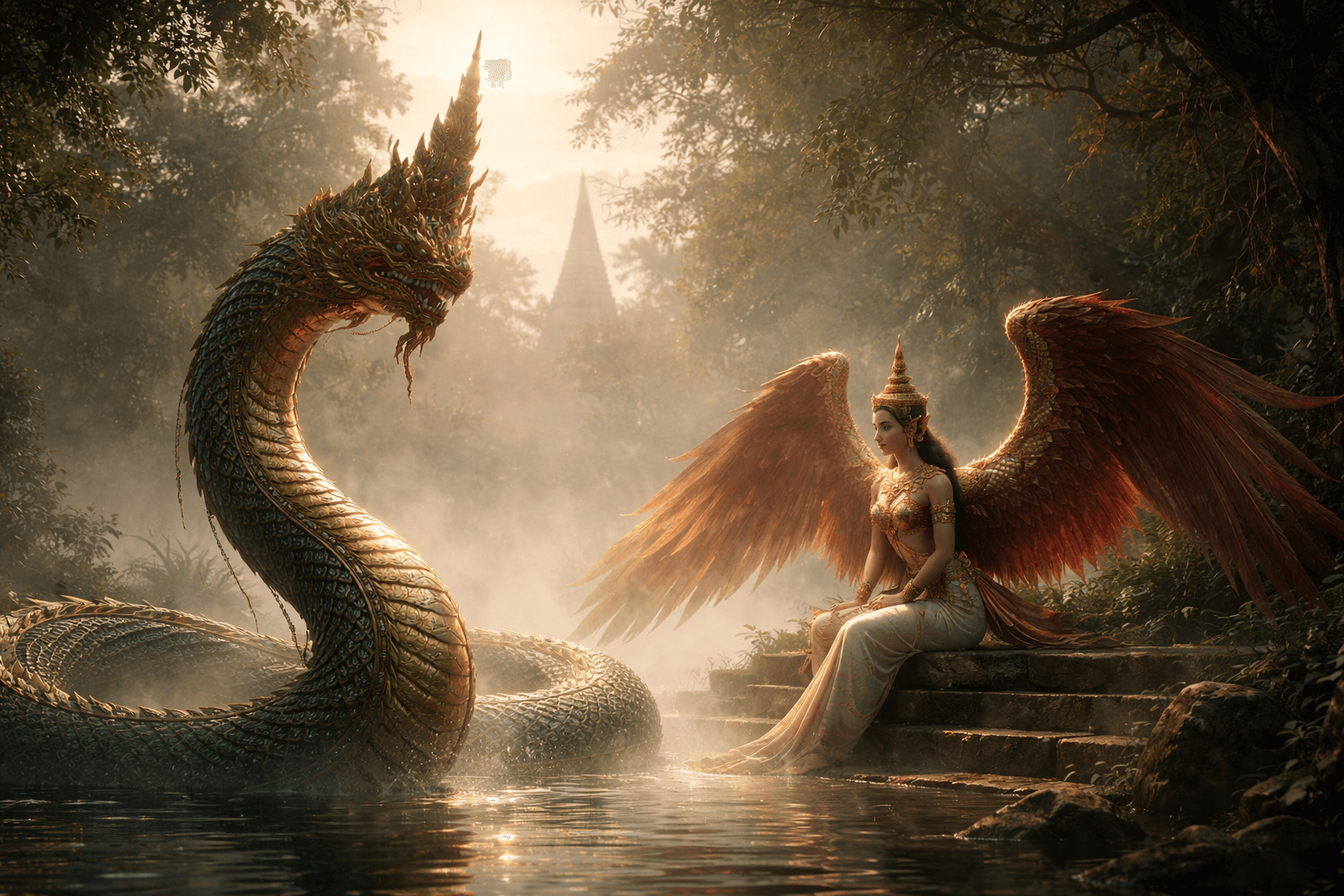
Long, long ago, in the days of the glory of the Kingdom of Ayutthaya, when the palaces shimmered with gold and the river carried the reflection of the sky like spilled silk, a deep drumbeat resounded through the kingdom, silence fell, and lips whispered: “Where is Aranphong?”
Eyes lifted to the sky, he perceived the clouds gently drifting above his head, passed through the market without noticing the scent of spices and sweat accompanying his path. He found himself somewhere he had never been before. A river, a temple, and a tree that evoked a feeling of silence.
“I will sit here and rest,” he thought, and so he did. The majestic Samanea granted him heavenly shade and peace. He closed his eyes and enjoyed what he could not at court.
“Bzzz, bzzz,” and sleep was gone, so brief; he looked at the bee that had disturbed him. He was just about to say something to it, but his gaze was led to the idyll beyond it.
Before him opened stone steps, disappearing into the Chao Phraya River; on the steps a girl, beautiful as a painting, long black hair tied in a knot. With gentle hands she scoops water from a clay vessel and pours it over the stone. The water flows in narrow streams between the cracks, carrying with it fine sand and dust from the night. A few thin strands of her hair mischievously tickle her face. They annoy her. She looks at them, speaks to them, and tries to blow them away, and with each breath the sash draped over her shoulder shifts. She is slender, her clothing likely once belonged to an older sister.
Aranphong watches her, quietly, so as not to disturb the moment. He does not even breathe, just in case it might only be a dream. No one in his life had ever evoked such a feeling of peace as she does now.
The girl rises, sensing his attention, their gazes meet… the moment stops, the world around them disappears. Shyly she smiles, lowers her head, and runs into the temple.
A gong sounded. Noon. Aranphong realized he had crossed a boundary he had not seen that morning. He turned his steps back toward the palace.
In the reception hall his father awaited him, and his gaze was heavier than the gold on the walls.
“Why did you leave the gates without an escort?”
Aranphong lowered his head. “My mind was not at peace. I did not wish to bring its unrest before you, Father.” He walked to his chamber and devoted himself to the study of lineage.
One hour, two, three, Aranphong still did not know what he was reading; his thoughts returned to those steps, to her. He could not detach himself from her. And so his walks became more frequent; he went and watched and tried to catch sight of her again.
One afternoon, when the sun was not yet weary, Aranphong put on plain cloth instead of silk and walked the path his heart already knew better than his feet. He passed through the familiar market and inhaled the atmosphere of ordinary life. As he turned to admire the beauty of lotus flowers, he heard “Ouch.” “Forgive me, I did not see…” It was her; their gazes met, their lips remained speechless. “Have we met before?” she asked. “Perhaps,” he replied.
“Take this to your father, Maliwan. Let him prepare the altar before the evening recitation,” a monk addressed the girl, handing her an armful of lotus flowers.
“Yes, bhante.” Maliwan took the flowers, gently smiled at Aranphong, lowered her head, and left.
“Maliwan,” what a beautiful name. Aranphong said quietly to himself and returned to the castle.
Days and nights changed, and Aranphong went to the temple more and more often. Sometimes because of an offering to the temple, at other times bearing a gift. The true reason, however, was something else; he longed, if only for a brief moment, to see Maliwan.
Good morning, the temple doors opened and her eyes saw Aranphong. The wooden ladle fell to the floor. Thud, it broke their gaze. Before she realized it, Aranphong was handing her the ladle. A chance touch of hands, closed eyes, and the words “Do not go today.” In fright she realized she had spoken those words aloud.
“My name is Aranphong,” he said softly, took the things she carried, and followed her to the river. He sits beside her and watches. Their mutual presence causes their conversation to find direction. It becomes their happiness, their need.
Aranphong returns often and their conversations defy time. She speaks of the life of a Brahmin priest’s daughter; he of limitations.
Love did not come suddenly.
It came quietly.
He began to notice that when he returned to the palace, the world was sharper. Colors stronger. At night he could not sleep because he thought of her laughter, which was not loud, but carried light within it.
She began to realize that when she heard footsteps on stone, her heart quickened even before she knew why.
The river darkened before the sky; a storm approaches. “I must return to the castle again,” he said and departed.
“Your steps have lately led too often to the river,” his father said.
Aranphong remained silent for a moment.
“If a woman were not of the courtly lineage, yet were virtuous, could she stand by my side?” he continued.
“Your marriage is not yours, Aranphong. Your heart belongs to you, but your marriage to the kingdom,” his father replied.
Aranphong’s eyes grew heavy; he thanked his father for the answer and made his way to his chamber. On the way he watched the rain that drenched the entire kingdom with its tenderness. He thought about the weight of his fate, about how he could have everything and yet it could mean nothing.
One evening, they were simply lying by the river, speaking of everything and nothing. Aranphong nibbled lotus seeds from a flower the river had carried to him.
“If you eat while lying down, you will be a serpent in your next life,” she said and laughed.
He laughed and sat up.
Mist rose above the river, the sun began to retreat.
“If I were not who I am, would you be mine?”
She looked at him longer than was safe.
“You are who you are,” she answered. “The question is who you want to be.”
For the first time he took her hand, not passionately, but firmly. Their gazes met; both felt certainty like never before.
The temple doors opened; for a moment the priest’s gaze interrupted them. Maliwan remained serious, lowered her head, and went home.
“Power takes more than it gives. I do not want you to become its victim,” her father said in the doorway.
When they next met, it was not only air that stood between them. Fear stood there.
“They forbade me,” she said.
“Me as well,” he replied.
For a moment neither moved.
Then she took a step toward him.
“So what shall we do?” she whispered.
In his eyes a struggle appeared for the first time—not against the world, but against himself. Against everything he had been taught.
“If I leave,” he said slowly, “I will not return.”
Her fingers tightened around his palm.
“Then stay with me,” she said.
He returned the grip.
“So what shall we do?” he asked.
“Come!” she whispered and pulled him by the hand, running toward the nearby temple.
“Bhante, bhante!” she spoke urgently.
She found him, the monk she sought. The one who had stood by her since childhood as her personal guardian.
“Bhante, what am I to do?” she told him the whole story and the worries that burdened her.
“Maliwan, you cannot do this, no one will approve it,” the monk said.
Tears came to her eyes, her gaze fell.
“We will run away together,” Aranphong said. “We will find our place where no one knows us, where we will be only a man and a woman.”
The monk shook his head. The force of their love took his breath away.
“Very well then,” he said, “if you truly wish to be only a man and a woman, come.” He lit incense and began to recite:
“Thus have I heard: At one time the Lord was dwelling at Sāvatthī, in Jetavana…”
Only oil lamps shone in the temple, incense scented the air, and Aranphong’s deep gaze into her eyes gave her certainty in this step.
Their wrists were bound with a white thread, and through the silence carried:
“May your union be founded on truth, not on desire. May your minds be stronger than fear.”
Hands naturally intertwined were now bound also by blessing.
“We accept your blessing, bhante,” they said gratefully.
The temple remained silent behind them. The oil lamps were still fading as they stepped beneath the night sky.
The rain had ceased, but the ground was soft and the air heavy.
Aranphong stopped beneath the bamboo that leaned over them like whispering witnesses.
“Beyond the forest,” he said more quietly than he had intended, “there is a small village. Fishermen. No one knows us there. We could begin a new life there.”
Maliwan looked at him.
“And your name?” she asked.
“And your duties?”
“We will leave them behind the river,” he said firmly.
She knew it was not so simple.
But she also knew that if she stepped back now, she would never decide again.
She took his hand. “Come.”
They passed through a bamboo grove where the wind made a hollow sound between the stalks. The ground was slippery, soaked by rain. From afar the river could be heard, stronger than during the day.
Behind them the city seemed calm. Too calm.
Aranphong looked back once. “When it grows light,” he said, “they will search for us.”
Maliwan nodded. “Then let us go before it grows light.”
The bamboo gave way to tall grasses.
Before them opened a narrow bank where the river bent and undercut the soil.
The water was darker than the night.
Aranphong helped her step over a slippery root.
Beneath their feet the earth trembled.
For a moment they stopped.
Crrk, the bank beneath them first only cracked.
Aranphong inhaled sharply.
“Maliwan—”
The earth slid from beneath their feet. The soil crumbled like wet sand. Her foot slipped, her hands dug into his wrist.
“Hold on!” he breathed.
The water below them roared — a deep, dark whooo that swallowed the night.
For a moment they hung between earth and river. It would have been enough to let go.
Just one movement.
His fingers tightened even more.
“Do not be afraid,” he whispered, and his voice broke.
Crrrrk! The last piece of bank broke away.
They fell. The air knocked the breath from their lungs.
The water received them violently. Cold penetrated to the bones. The current dragged them deeper than they expected. Aranphong tried to swim up, but heavy cloth wrapped around his legs.
“Mali—!” water filled his mouth.
In the darkness beneath the surface he felt her hand.
She clasped his palm so calmly. “Do not leave…” she breathed.
Their final exhale dissolved between them in bubbles.
Their bodies sank. Their minds, however, did not descend in the same direction.
Above the surface the wind passed through the bamboo. And then only the river sang its heavy, unceasing whooooo…
Darkness, that unreal darkness, but it is not empty. I cannot feel my hands, I cannot move my shoulders. “Put strength into it, open your eyes, you can do it!”
Water, everywhere water and that cold. I am not breathing, wait I do not need it. What is this feeling. “Push once, two,” and with each slight movement he mastered his direction in the river. He looked down, no palms. Only the shadow of a long, undulating body.
“Do not leave!”
He stopped. “Where did that come from? What am I? Where am I swimming?”
He rose to the surface and saw light, light that hurt, like something lost.
Beneath the surface his body coiled by itself, tight, ready.
And the river accepted him as its own.
He sank deep, understanding that to brace himself against the bottom and the roots there was easier for him. He swam diagonally against the current, as he had always done, watching the murky water and movement around him. Snap, the first hunt and success, the first fish. But why that feeling of emptiness.
Days changed and he grew. He found his favorite place and all quickly understood it was his. Other serpents did not go there. The people who lived nearby believed he was the guardian there. Phaya Nak Khung Yai, they named him, and from afar they watched the rippling of the water above his robust body.
He often emerged from the water onto the stone steps and basked in the sun. He felt peace and acceptance there. There the emptiness was silent.
A new day came, the sky heavy after rain, and a monk from the nearby temple watched the rippling of the water above Nak’s body. On the horizon he saw something unseen before. A bird, not an ordinary one, the noble Phala Garuda of a distinguished lineage. How had she come here, so far from home.
She flew over the river, saw the waves. Nak leapt high, so high he himself did not believe he could, his leap accompanied by a watery eruption, his strength admirable. He missed; he did, Garuda did not. She was an excellent flyer; with a simple maneuver she avoided the attack and seized Nak in her talons. An aerial battle of giants began, talons embedded in Nak’s body, which coiled around the massive bird. It did not last long and both fell onto the grass near the river. “But why that feeling?” Nak loosened his grip, left his life at the mercy of her decision. He crawled back toward the river when instead of the expected death came “Do not leave!” He remained frozen on the grass so familiar, between the steps and that great tree that brought such peace. He turned and returned to the recent battlefield. Their gazes met and did not release.
Garuda built her nest in the crown of that tree and daily basked in the sun by the steps together with Nak, who quickly became so precious to her. They sat, enjoyed the sun, and shared their worlds. Garuda spoke of flying in the sky, of the view from above; Nak of the cold world beneath the water. At his words Garuda froze and tears flooded her eyes. Nak embraced her with his body; this time the feeling was entirely different. Such a cold body and yet it soothed her need, calmed her senses.
The priest serving in the temple watched the séance of these mythical beings every day; he did not miss today either. He simply stood there with tears in his eyes and one word hanging on his lips: “Maliwan.”
Old fishermen say that on days when sky and water merged into one mist, above the river one could hear a breath that belonged neither to bird nor serpent.